
Interactive Romance, Explained: Stories Where Your Choices Matter
Interactive romance stories are authored romances where you play the main character and make the choices at the moments that matter: what you say, what you hide, whether you lean in or walk away. The story remembers those choices, and later chapters change because of them. The love interest, the world and the plot are written by an author. What you decide shapes how the tension between you plays out.
What is an interactive romance story?
An interactive romance story is a romance novel you take part in. It is written in second person, so "you" are the heroine, and at key points the narrative stops and asks you to decide something. Unlike an old gamebook, the decisions are rarely about which corridor to take. They are about the things romance readers actually care about: whether you tell him the truth, whether you answer the question he just asked, whether you let the almost-kiss become a kiss or step back from it.
The important word is authored. An interactive romance is not a blank sandbox or a generator making things up as it goes. Someone wrote the love interest, decided what he wants and what he is hiding, plotted the cliffhangers and built the world. Your choices move through that structure. The best comparison is a well-plotted novel that has been built with hinges in it, so that a handful of doors can swing more than one way.
How do choices work in interactive romance?
Choices in interactive romance work by recording a decision and paying it off later. At a choice point you get two or three options, usually framed as dialogue or action. The story notes which one you picked. Sometimes the effect is immediate, a different reply or a different reaction on his face. Sometimes it waits, and three chapters later he brings up the thing you said on the balcony.
That second kind is where the format earns its keep. Readers who have spent time with choice-based stories tend to sort them into two piles:
- Stories where choices are remembered. You refuse to tell him your name in Chapter 2, and in Chapter 5 he still does not know it, and he is visibly annoyed about it. The story feels like it is paying attention to you.
- Stories where choices are cosmetic. Whatever you pick, the next scene plays out identically, perhaps with one line swapped. Readers call this the illusion of choice, and once you notice it, you cannot stop noticing it.
There is also a third failure people complain about: the story that contradicts you. You turned someone down, firmly, and two scenes later the narrative has the pair of you acting like a couple anyway. Nothing breaks immersion faster than a story forgetting a decision you made on purpose.
The tagline Almost Kiss uses is "Romance that remembers you", and that is the standard worth holding any interactive romance to. A choice only matters if the story treats it as true afterwards.
How is interactive romance different from a regular romance novel?
The difference between interactive romance and a regular romance novel is who controls the heroine. In a novel, you watch her make decisions, and half the pleasure is yelling at her when she makes the wrong one. In interactive romance, the decision is yours, so the tension lands differently. When the love interest says something devastating and the story waits for your answer, you are not reading about restraint. You are practising it.
That shift suits certain tropes particularly well. Slow burn romance runs on the moment someone chooses not to act, and being the one who makes that choice turns the burn up. Enemies to lovers works too, because every exchange is a small decision about how much ground to give. If you know how enemies to lovers is built, you can feel the format pressing on exactly those beats.
What interactive romance keeps from the novel is the authored voice, the pacing and the cliffhanger. Chapters still end on a hook. The love interest still has an inner life you only glimpse. You are still reading prose, not ticking boxes.
Is interactive romance the same as a romance game?
Interactive romance fiction and romance games overlap, but they are not the same thing. A romance game, including most visual-novel style dating games, is built around systems: affection points, stat checks, routes you unlock by playing the same opening several times, sometimes puzzles or resource management on top. The romance is one goal among several, and the experience is shaped by the mechanics.
Interactive romance is a story first. There is no meter to fill and no optimal path to look up. You read, you choose at the moments that matter, and the payoff is emotional: the scene where he finally says the thing, written by someone who knew you would be holding your breath.
A simple way to tell them apart is to ask what you are trying to win. If the answer is a route, a score or an ending you need a guide to reach, it is a game. If the answer is the feeling of a scene landing exactly the way a good romance novel lands, it is interactive fiction.
What makes an interactive romance story good?
A good interactive romance story does three things well:
- Its choices have consequences you can feel. Not necessarily huge plot swerves. A love interest who remembers what you told him and lets it change how he treats you is worth more than ten branching endpoints that never reference each other.
- Its characters remember. The love interest should carry the history of your conversations the way a real person would. If you have been guarded, he notices. If you have been honest, he trusts you with something back.
- Its plot is authored and has cliffhangers. Interactive does not mean shapeless. The strongest stories have a premise that grabs you in one line and chapter endings that make stopping feel physically difficult.
That premise matters more than people expect. Take Marked: one mouthful of your blood buys a vampire the sun, the King of the city, Lucian Vale, had it on his lips and stopped, and now you have seven nights under his roof wearing his mark. That is a hook that tells you the stakes, the love interest and the tension in one breath, and it puts you at the centre of every choice that follows. Readers who love vampire romance will know exactly what kind of restraint they are in for, and anyone with opinions about the vampire king trope will recognise the shape of a man with all the power who chooses not to use it.
Or The Authenticator, a romantic suspense story: Eli Fontaine answers you at any hour of the night, every time, without fail, and tonight you find out what he deletes. The question the story opens on is not whether you like him. It is how much you trust him, which is the kind of question an interactive story is built to make you answer yourself.
And at the lighter end, Play Along opens on a romantic comedy setup readers will recognise instantly: you lied in the group chat about bringing someone, and before you could take it back, Jude Alvarez typed me. It is fake dating with all the familiar machinery of the trope, and the fun is in the premise doing the work from the first page.
What should you look for before you start one?
Before starting an interactive romance, look for four things:
- A free first chapter. You should be able to meet the love interest and feel the premise before paying for anything. On Almost Kiss, Chapter 1 of every story is free, no sign-up.
- A clear content register. Know what heat level you are getting. Almost Kiss is written for readers 18+: plenty of chemistry, tension and wanting, no explicit scenes.
- Complete stories. A finished, authored story with an arc is a different experience from an endless serial that never resolves anything.
- Tropes you already love. Interactive fiction amplifies a trope rather than replacing it. If you live for a possessive love interest, a rival you cannot stand or a best friend who has been quietly in love with you for years, start there.
The easiest way to find your fit is to browse by premise. The full Almost Kiss library lists every story with its hook, love interest and genre, from shifter and Regency romance to medical and sci-fi, and you can open any one of them at Chapter 1.
Where to start
If you want the clearest sense of what a remembering story feels like, start with Marked: seven nights, a vampire king who stopped when he should not have, and every choice you make under his roof counting. Chapter 1 of every story is free, no sign-up, so you can step into Lucian Vale's city tonight and see whether you are the kind of reader who walks away or the kind who stays.
Read it as a story
-
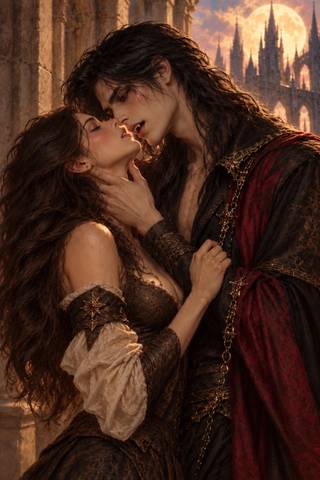
Dark Romantasy Vampire
Bloodbound
with Severin Morcant
Your blood is the one thing every vampire alive would kill for, and the only one who won't take it is the man you came to kill.
Read Chapter 1 free
-

Romantic comedy
The Ghost Note
with Nico Serrano
Everyone in the building gets the mask, and you are the only one who gets his face.
Read Chapter 1 free
Questions readers actually ask
What is an interactive romance story?
An interactive romance story is an authored romance in which the reader steps into the main role and makes decisions at key moments. Those decisions are remembered, so later scenes shift to reflect them. The love interest, the setting and the central conflict are written in advance, but how the tension plays out depends partly on what the reader chose.
How do choices work in interactive romance?
At certain points the story pauses and offers two or more options, usually about what you say, what you admit or whether you step closer. The story records the decision. A good interactive romance brings that choice back later, through a line of dialogue, a changed reaction or a scene that only happens because of what you picked.
Can I read interactive romance stories for free?
Many interactive romance apps let you start free. On Almost Kiss, Chapter 1 of every story is free with no sign-up, so you can read the opening of any story in the library and decide whether the love interest and premise are worth continuing before committing to anything.
Is interactive fiction the same as a romance game?
Not quite. A romance game usually centres on systems such as stats, routes, points or puzzles, and the romance is one reward among several. Interactive romance fiction is a story first. You read prose, you make decisions at the moments that matter, and the payoff is emotional rather than a score or an unlocked ending.