
Obsession as Devotion: The Trope Romance Readers Defend Hardest
The obsessive love interest trope is popular because it strips out ambivalence. Ordinary attraction arrives hedged — maybe, later, if the timing improves — and obsession settles the question permanently. He decided before she asked, and he cannot be argued down. What readers actually want from it is not the surveillance. It is being chosen by someone who will never be quietly reconsidering.
That distinction does a lot of work, and most of the arguments about this trope collapse if you skip it.
Nobody is fantasising about being followed
Readers who love this trope get accused of wanting a stalker, which misreads what is being consumed. The appealing part is the certainty. Real attraction is a long negotiation of interest levels, and almost everyone has had the experience of being liked provisionally — enthusiastically on Thursday, vaguely by Sunday, always with the sense that a reassessment is underway somewhere out of sight. Obsession in fiction is the total absence of that. He is not reassessing. He has thought about her every day for six years and the thinking has never once trended downward.
That is why the vocabulary around this trope is so specific. He fell first and he fell harder. One woman only. She is his whole personality. All three phrases describe the same thing from different angles: interest she does not have to maintain. The intensity is not the point so much as the permanence, and the intensity is how a book proves permanence quickly, because a novel does not have six years to spend.
Jane Austen wrote the cleanest version of it and did not need a single threat to do it. Captain Wentworth spends eight years being unable to stop, and when he finally writes it down — half a letter, in a room full of people, while pretending to do something else — the force of it comes from duration. He has been thinking about her the entire time. Nothing has been added except evidence.
Obsession is not a personality, and books keep using it as one
The failure mode is so common it has become the default. A love interest is introduced as obsessed, and that is the end of his characterisation. He glowers. He appears. He says mine. Two hundred pages later he has no opinions about anything except her, no work he is neglecting, no rival he is disappointing, nobody who has noticed he has changed.
Obsession only reads as devotion when there is something for it to displace. This is the same structural rule that makes the touch her and die trope work when the threat costs him something: the gesture has to be spent out of a finite account. A king who cancels a council he has been building toward for a decade because she has a fever is telling you what she is worth. A man with an empty calendar is telling you nothing. He was free that afternoon anyway.
The best writers of this trope are ruthless about the ledger. He is late to something that matters. He makes a decision his own people consider insane and then has to live in the organisation he has damaged. Someone who has known him for thirty years says you used to be careful and he does not have an answer. All of that is characterisation of him, not of her, and it is what separates a devoted love interest from a mood.
It also has to sit on top of a person who existed before she did. Morally grey love interests hold together because their reasoning is legible — you can see the logic that produced them, even when you would not sign it. Obsession applied to a blank produces a blank who stares.
The line: what he does when she is not the answer
Here is the test that actually separates the two words, and readers apply it instinctively even when they do not say it out loud.
Devotion is organised around her. Obsession is organised around his need for her. For most of a book those look identical — same attention, same intensity, same inability to leave the room — because they only diverge at one specific moment: when serving her interests means losing access to her.
Devotion puts her on the ship. It funds the education that takes her four countries away. It tells her the true thing that gives her grounds to leave, and then stands there while she considers it. Obsession finds a reason why the ship is not safe, why the timing is wrong, why she would be happier here. It always has a reason, and the reason is always about her wellbeing, and it always arrives at the same destination.
The other tell is information. A love interest who manages what she is allowed to know has already decided she is a thing to be kept rather than a person to be consulted, and every book that runs this trope well eventually makes him pay for that specific decision. She finds out. It is a betrayal, not a misunderstanding, and it is treated as one.
Heathcliff is the canonical warning precisely because he passes every obsession test and fails every devotion test. He never stops. He also never once does anything that serves Catherine rather than his own claim on her, and Wuthering Heights is scrupulously clear that this is a catastrophe rather than a romance. Two centuries of readers have found him magnetic anyway, which tells you something honest about the appetite — and the novel's refusal to call it love is what keeps it from being irresponsible.
Where it curdles
Obsession that predates knowing her. If he was fixated before they exchanged twenty words, the object is a projection. Books get away with this in paranormal romance by making it metaphysical, but even then the strongest versions insist he would have arrived at the same place without the bond.
A heroine with no project. If she has no work, no competence and no plot of her own, the trope becomes a man having enormous feelings near furniture. She needs something she wants more than she wants him, at least for a while.
Escalation standing in for development. Each act is more extreme and nothing between them has deepened. By the third grand gesture it is ambient, and the reader has stopped registering it.
A book that does not know. Framing is the whole thing. A story that lets her be genuinely furious, that makes him lose something real, that treats an overreach as an overreach, is doing the trope well. A story that presents the same behaviour as uncomplicatedly swoonworthy is asking the reader to endorse something she never agreed to — which is where the trope slides out of morally grey and into villain romance, where the appeal is the transgression itself. That can be a great book. It should just know which book it is.
The retroactive excuse. Trauma explains behaviour. It does not discharge it. If the backstory arrives late and is expected to settle the account by itself, the apology has skipped the part where he actually earns it back.
Fiction and a relationship are different objects
Worth being plain about, because the discourse is exhausting and the honest answer is short.
An obsessive love interest in a novel is safe in a way his real-world counterpart is not, and the reason is structural rather than moral. He is authored. His intensity has a shape, a duration and a guaranteed resolution, and the reader holds the exit — she can put the book down mid-sentence and he stops existing. None of that is available in a life. Off the page the same behaviour has no author, no ending and no promise that the attention will keep pointing the same direction.
Readers do this arithmetic constantly and are usually more clear-eyed about it than the people worried on their behalf. The genre's own critics tend to be internal: the arguments about whether a particular book handled something with care, or just used it for shock, happen inside romance communities, in detail, by people who read a great deal of it. That is a healthy sign, not a scandal. Enjoying a dynamic in a controlled space is not the same as recommending it, and nobody needs a disclaimer to know the difference between a fantasy and a plan.
What that leaves is a craft question, which is the more interesting one anyway: does the book know what it is depicting? A novel that understands its love interest is frightening, and lets that be true, can then do the thing readers came for — show him choose restraint while remaining fully capable of not choosing it.
The quiet version is the strongest one
Obsession is made of attention, and attention is cheap to render and impossible to fake. He knows how she takes her tea, which stair creaks, what she does with her hands when she is lying. He stands at a distance he could close in one step and does not close it. He answers one question honestly, having refused the same question from everyone else in the book.
None of that needs a single explicit line, which is why the trope thrives in slow burn and lower-heat romance as much as anywhere darker. The rejected mate storyline runs on it hardest — devotion that survives being turned down is the only version that proves it was a choice rather than a compulsion, which is the spine of Unmated, one of the stories on our shelf.
That restraint is the register we tuned MARKED to — an interactive vampire romance where your choices steer the story, where a king who has been careful with nobody for four hundred years is careful with you, and remembers what you chose three episodes ago.
Chapter 1 is free, so you can hear how he speaks to his court before you hear how he speaks to you. Start reading MARKED. Chapter 1 is free, no sign-up — start below.
Read it as a story
-

Dragon romance
What Fire Cannot Hoard
with Riven of the Red Vale
You went up the mountain to bind a dragon to the valley he was bleeding dry, and the spell bound him to you.
Read Chapter 1 free
-

Paranormal romance
When the Demon King Knelt
with Elias Vane
A man is kneeling in the rain outside your bookshop, and the first true thing he says to you is that he killed you.
Read Chapter 1 free
-
Dark paranormal romance
Marked
with Lucian Vale
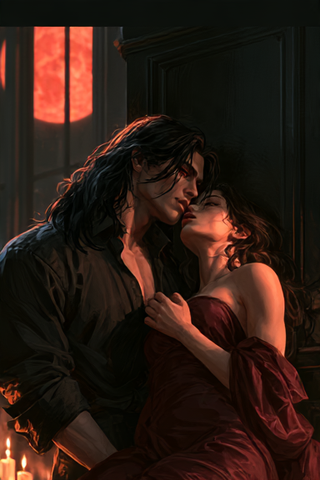
One mouthful of your blood buys a vampire the sun. The King of this city had it on his lips and stopped — and now you have seven nights under his roof wearing his mark, and the only thing hiding you burns off every time he touches you.
Read Chapter 1 free
Questions readers actually ask
Why is the obsession trope popular in romance?
Because it removes ambivalence. Ordinary attraction comes hedged with timing and conditions, and an obsessive love interest has already finished deciding. The fantasy is not being watched. It is being chosen by someone who is not quietly weighing you against other options, and who never will.
What is the difference between obsession and devotion in romance?
Devotion is organised around what she needs. Obsession is organised around what he needs from her. They look identical until the two things conflict, and the test is what he does when serving her interests means losing access to her. Devotion lets go of the access.
Is the obsessive hero trope problematic?
In life the behaviour is a serious warning sign, and readers know that. In fiction it is a controlled object with an author, an ending and a reader who can close the book. The question worth asking is not whether the trope is allowed but whether a given book knows what it is depicting.
What is the one woman only trope?
A love interest who is capable of wanting exactly one person and has been for a long time, often before the story starts. It overlaps with he fell first and harder, and it appeals for the same reason — his interest is not a phase she has to keep earning.
Can an obsessive love interest work in a closed-door romance?
It works better there, arguably. Obsession lives in attention rather than contact — what he has memorised, the distance he could close and does not, the question he answers only for her. Lower-heat and closed-door books run the trope constantly, because restraint is the whole point.