
The Touch Her and Die Trope: Violence as a Love Language
The touch her and die trope is the moment a dangerous character makes it explicit that harming one specific person will cost you everything. It works because it converts a threat into a declaration — violence is the only currency this character genuinely deals in, and he is spending all of it on her. It only lands, though, when the book also shows how carefully he treats her.
That second half is where most books lose it, and it is worth being precise about why.
A threat is a price, and love is free
Anyone can say the words. They cost nothing, which is exactly why romance has spent two centuries finding ways around them — the glove left behind, the letter burned, the man who rides three days in bad weather and then says nothing at all. Declarations are cheap. Proof is expensive.
A threat is expensive in a very specific way: it is a stated price, quoted out loud, in front of witnesses. When a man who runs a criminal organisation tells his own lieutenant what will happen to anyone who touches her, he has just published her value in the only unit his world respects. He is also creating a liability. Everyone in that room now knows precisely where to hit him.
That is the whole engine. Three conditions have to hold for it to fire.
The capability has to be real. If he could not actually do it, the line is bluster and the reader clocks it instantly. He needs a body of evidence — not on-page carnage, necessarily, but a reputation the narrative treats as earned.
The exemption has to be specific. Not women, not innocents, not people in his employ. Her. A hero who protects everyone vulnerable is a good man, which is lovely and a completely different trope. This one requires that the rule exists for one person.
The audience has to be the world, not her. The line is said to a rival, a subordinate, a brother, a room. She frequently is not present, or is barely conscious, or does not understand what she has just been given. Said directly to her, in the first act, it reads as intimidation. Said about her, it reads as a claim staked on her behalf.
The contrast is the trope. Everything else is set dressing
What readers are actually consuming is not the aggression. It is the gap between how he handles the world and how he handles her, and that gap only exists if both halves are on the page.
This is where books fail, and they fail in the same direction almost every time. Four hundred pages of menace, atmosphere, gunmetal and low-voiced warnings — and then approximately one scene of him being gentle, usually near the end, usually while she is unconscious. The threat has nothing to be measured against. He isn't a dangerous man who is careful with her; he's just a dangerous man, and she happens to be nearby.
The scenes that get screenshotted and passed around are almost never the threats. They are what happens thirty seconds afterwards. He fixes the strap of her shoe. He answers a question he has refused to answer for the entire book. He goes quiet and stays quiet, and someone else in the scene notices that he has gone quiet, because they have never seen him do that. The violence establishes the scale. The tenderness is the actual event, and it needs three or four appearances, not one.
The smallest usable unit of this trope is the who did this to you moment: he registers an injury he did not cause, and the temperature in the room drops. It works because he stops being fluent. A man who has been controlled and articulate for two hundred pages loses the thread of his own sentence. That is the tell readers are there for.
It also pairs naturally with morally grey love interests, and the line between complicated and just awful, for the same structural reason: the restraint only counts if he remains fully capable of the thing he is choosing not to do. Redeem him too early and the trope evaporates. He has to still be the person the warning was about.
Mine, and the trouble with metaphysics
Paranormal romance has a shortcut here, and it is a genuinely good one. Mate bonds, blood bonds and claiming rituals convert temperament into physics — the possessiveness stops being a personality trait he could theoretically manage and becomes a condition of his existence. Blood bonds in vampire romance do this particularly elegantly, because the connection runs both ways and he is as exposed as she is.
The risk is that the same shortcut can quietly do the choosing for him. If the bond compels him, his devotion is weather. Nobody is impressed by a man who cannot help it. The versions that work tend to insist on both: the bond exists, and he would have arrived at the same place without it. The rejected mate storyline is popular for precisely this reason — it forces someone to choose against the metaphysics, which is the only way to find out what the metaphysics was worth. It's the spine of Unmated, one of the stories on our shelf.
The other place this runs hot is court fantasy, where the vampire king trope gives the threat political teeth. When he announces that she is not to be touched, he is not just being romantic, he is redistributing power in a room full of people who were relying on the old arrangement. The threat has consequences he will be paying for by chapter nineteen. That is what makes it feel weighty rather than decorative.
Protective or controlling: where the line actually sits
Readers argue about this constantly and both camps are arguing in good faith, because the two things are made of the same material. Four tests separate them reliably.
Which direction does the threat point? Outward at the people who would harm her, or inward at her own options? "Anyone who touches her answers to me" and "you're not going" are not the same sentence, and books that treat them as interchangeable are the ones that generate the arguments.
Does he manage her information? Withholding a danger from her for her own good is the single clearest marker. It says she is a thing to be defended rather than a person to be consulted, and it is almost always the first symptom.
Can she overrule him? She should be able to say no to his protection, and he should stay. Sulking is fine. Leaving, punishing, or simply going around her is not.
Does the book know? Framing is everything. A story that presents his overreach as an overreach — that lets her be furious, that makes him lose something for it — is doing the trope well. A story that presents it as swoonworthy and moves on is asking the reader to agree with something she has not agreed to.
Romantasy gave us the clearest illustration of this in a decade in A Court of Mist and Fury, where the same protective impulse is run twice with opposite results: one partner confines Feyre in the name of safety, another hands her weapons and a job and lets her walk into the danger with him. Identical motive. Completely different book. Readers understood the distinction immediately, and have been using it as a measuring stick ever since. Fourth Wing works a similar seam — Violet spends a long stretch reading Xaden as the threat before she can read him as the shield, and the reversal only pays off because his capability was never in question.
The failure modes worth naming
Body count as substitute for intimacy. Each act escalates, nothing between them deepens. By the third one it's ambient. Escalation is not development.
A heroine whose only function is to be defended. If she has no project, no competence and no threat of her own, the trope becomes a man having feelings near an object. The strongest versions give her a form of danger he can't match — political, social, magical — so the protection is mutual rather than custodial.
Jealousy wearing protection's coat. A man who threatens someone for harming her is protective. A man who threatens someone for talking to her is telling you what the rest of the relationship will look like, and readers who have been burned before will put the book down.
Nobody pays. If his stated exemption costs him no allies, no leverage, no sleep, then it was never a price. It was a line of dialogue. The whole trope rests on the idea that he has made himself more vulnerable by saying it out loud, and if the plot never collects, the reader has been shown a receipt for a transaction that didn't happen. This is also why the trope sits so comfortably in dark romantasy, where the stakes are built to hurt.
None of it requires anything explicit, incidentally. The most effective version of this trope is a held breath: a hand that goes still on the back of a chair, a name he asks for and does not get, someone who stops appearing in the story without explanation. Restraint is the register. It always was.
That's the exact frequency we tuned MARKED to — an interactive vampire romance where your choices steer the story, where the threat he makes on your behalf costs him something with his own court, and he remembers what you chose three episodes ago.
Chapter 1 is free, so you can find out how he speaks to everyone else before you find out how he speaks to you. Start it here. Chapter 1 is free, no sign-up — start below.
Read it as a story
-

Paranormal romance
When the Demon King Knelt
with Elias Vane
A man is kneeling in the rain outside your bookshop, and the first true thing he says to you is that he killed you.
Read Chapter 1 free
-

Fantasy romance
The Princess and Her Impossible Knight
with Rowan Thorne
Someone wants your blood before the Blood Moon, and the only man standing between you and the arrows is the knight who has been in love with you his whole life.
Read Chapter 1 free
-
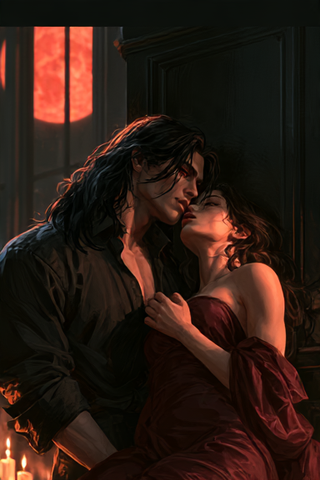
Dark paranormal romance
Marked
with Lucian Vale
One mouthful of your blood buys a vampire the sun. The King of this city had it on his lips and stopped — and now you have seven nights under his roof wearing his mark, and the only thing hiding you burns off every time he touches you.
Read Chapter 1 free
Questions readers actually ask
What is the touch her and die trope?
It is the moment a dangerous character states, usually to a third party, that harming one specific person will cost them everything. The threat functions as a confession. Because violence is the currency this character actually deals in, naming her price tells the reader exactly what she is worth to him.
Why do readers like possessive heroes in fiction?
Because possession is legible in a way ordinary affection is not. A man who is careful with everyone is only being polite when he is careful with her. A man who is careful with nobody else is telling you something specific. The appeal is the contrast, not the aggression.
What is the difference between protective and controlling in romance?
Protective points outward at the people who would hurt her. Controlling points inward at her own choices. The practical test is whether she can overrule him and he stays anyway, and whether he keeps her uninformed for her own good. If her agency shrinks as his devotion grows, the trope has curdled.
Does the touch her and die trope need explicit violence to work?
No. Most of the force lives in restraint — the hand that goes still, the sentence he does not finish, the person who quietly stops appearing in the story. Closed-door and lower-heat romance run this trope constantly, because the tension is in the capability rather than the demonstration.
Which subgenres use the touch her and die trope most?
Dark romance, mafia romance and romantasy lean on it hardest, since all three give the love interest real power to abuse. Paranormal romance builds it into the metaphysics with mate bonds and blood bonds, which makes the possessiveness literal rather than temperamental.