
Morally Grey, Explained: The Line Between Complicated and Just Awful
Morally grey means a character acts on a coherent internal code that doesn't line up with conventional morality — and the story is honest about the gap. They do genuinely troubling things, for reasons that hold together from inside their own logic. The label gets attached to almost every love interest in romantasy now, but most of them fail one half of that definition or the other.
Two failure modes dominate, and they're opposites.
The first is the man who is simply cruel and gets called complex. There's no code, no line, no logic — just unpleasantness the narrative asks you to find compelling because he's attractive and the prose says he's haunted.
The second is more common and more disappointing: the man who is described as dangerous at length and never does anything. Everyone in the book is terrified of him. He has a reputation. And across four hundred pages he is rude twice and then devoted. That's not morally grey. That's a golden retriever with good PR.
What it actually requires
Three things, and you need all three.
A code. He has rules. They aren't your rules, but they're consistent, and once you understand them you can predict him. This is what separates morally grey from chaotic — a character whose behaviour you can't model isn't morally complex, he's just noise. The reader should be able to say, by the midpoint, he will absolutely do this, and he will absolutely not do that.
Actual cost to someone. The troubling things have to land on the page and have consequences. If every terrible act happens off-screen, or only ever to people the narrative has already marked as disposable, the story is trying to have the aesthetic without the substance. Readers notice. It's why so many "ruthless" love interests feel weightless — the ruthlessness is always aimed at someone we never met.
No exemption from the narrative. The book has to know what he is. Not condemn him, necessarily — but not pretend either. The moment the story starts arguing that his choices were secretly fine all along, the greyness collapses into ordinary heroism with better lighting.
Why it works
The mechanic is contrast, and it's the same one running underneath enemies to lovers and most of vampire romance: a man who is dangerous to the world and careful with one person.
The reason this lands so hard is that it makes care measurable. Ordinary kindness is ambiguous — a man who is nice to everyone might be nice to you for no particular reason. But a man who is documented as capable of real harm, choosing restraint with one specific person, has produced evidence. There's a control group. You can see the difference.
That's the fantasy underneath the trope, and it's worth being clear about it: not the cruelty, the selection. Being chosen deliberately by someone who had no obligation to choose anyone, and who is visibly different with you than with everyone else alive.
Which is also why the trope fails the instant the gentleness isn't shown. If we're told he's soft with her but only ever see him being terrible, there's no contrast — just a man being terrible. Both halves have to be on the page.
Grey versus villain
These get used interchangeably and shouldn't be.
A morally grey love interest has a line. You may not know exactly where it is at chapter one, but by the end you do, and the story has tested it at least once — usually by putting her on the wrong side of it and making him choose.
A villain love interest either has no line or crosses it in front of you. That can be a completely legitimate book. But it's asking something different: it wants you to remain uneasy. The failure mode of villain romance is the retroactive softening — the third-act reveal that he was misunderstood, or working for the greater good, or that the people he hurt deserved it. That's not a resolution, it's a refund. If the book spends two hundred pages establishing that you're falling for someone genuinely dangerous, taking it back is a betrayal of the deal.
The redemption problem
The most contested question in the whole trope: does he have to change?
The honest answer is that the strongest versions don't reform him. They give him something to protect. He remains recognisably what he was — the same code, the same capacity, the same willingness — and the difference is that there's now one thing in the world he'd burn the rest of it to keep.
Sanding him into a conventionally good man is the most common ending and the least satisfying one, because it retrospectively deletes the thing the reader signed up for. If he's just a nice man now, the entire arc was a costume.
What he does owe is a reckoning. If he has genuinely wronged her — not been broody, actually wronged her — the grovel has to be real, and it has to cost. Three rules readers apply almost universally:
- It's behaviour, not speech. An apology is not a grovel. Changed action that she witnesses is.
- It costs him something he values. Power, standing, a plan he's held for centuries. If it's free, it's not repentance, it's convenience.
- She gets to choose. She accepts, on her own timing, or doesn't. A heroine worn down by persistence reads as a loss, not a reunion.
The heroine problem
Almost all of this discussion focuses on him, which is itself the trope's biggest weakness.
A morally grey love interest paired with a heroine who exists mainly to be chosen produces a book where only one person is actually present. If her entire function is to be the exception to his cruelty, she isn't a character, she's a category.
This is why the ruler variant is such a reliable home for the trope — a vampire king with a court to hold has consequences attached to every soft decision he makes. The pairings that work give her something of her own that his power can't resolve — a competence he needs, a loyalty that competes with him, or a moral line of her own that his behaviour keeps crossing. The last one is the most productive, because it means his choices cost him something with her every time. She isn't waiting to be won. She's deciding, repeatedly, how much she's willing to overlook.
There's also a version readers ask for more than the genre supplies: the morally grey heroine. A woman with her own body count and her own code, who isn't softened by being loved. When it appears it tends to be one of the most popular things in the book, which suggests the appetite is considerably larger than the supply.
How to spot the real thing early
If you want to know by chapter five whether a book is going to deliver, watch for one scene: him being genuinely frightening to someone who is not the heroine, witnessed by the heroine, with no explanation offered.
Books that give you that are committed. Books that keep his menace permanently off-page, safely in reputation, have already decided not to risk making you dislike him — and a love interest the author is protecting you from is not going to be morally grey. He's going to be very handsome and completely safe, which is a different book and, usually, a duller one.
If the contrast is the part you're there for — the man everyone in the room is afraid of, being careful with exactly one person — that's what MARKED is built around.
He's a vampire king with a court full of people who have every reason to fear him. You're the one who won't kneel. Your choices steer it, and he remembers every one of them, which turns out to matter more than you'd like.
Start reading MARKED free. The rest of the library leans the same way — Unmated is built around a man who refuses the rejection meant to set him free, and Terms & Conditions hands it to a bratva heir whose love language is clauses. Chapter 1 is free, no sign-up — start below.
Read it as a story
-

Paranormal romance
When the Demon King Knelt
with Elias Vane
A man is kneeling in the rain outside your bookshop, and the first true thing he says to you is that he killed you.
Read Chapter 1 free
-

Dark mafia romance
Terms & Conditions
with Lazar Tsarev
You came to kill him and he already had your name printed on the folder.
Read Chapter 1 free
-
Dark paranormal romance
Marked
with Lucian Vale
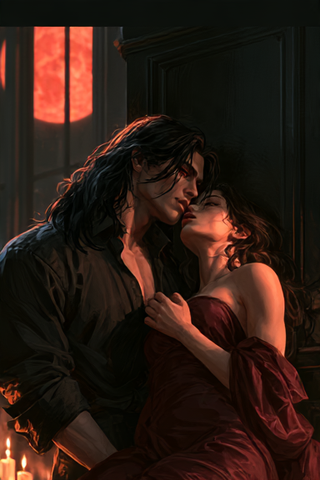
One mouthful of your blood buys a vampire the sun. The King of this city had it on his lips and stopped — and now you have seven nights under his roof wearing his mark, and the only thing hiding you burns off every time he touches you.
Read Chapter 1 free
Questions readers actually ask
What does morally grey mean in romance?
A morally grey character operates by a consistent internal code that doesn't match conventional morality. They do genuinely troubling things for reasons that make sense from inside their own logic. The key word is consistent — a character who is simply unpredictable isn't morally grey, they're badly written.
What is the difference between a morally grey hero and a villain?
A morally grey hero has a line they won't cross, and the reader knows roughly where it is. A villain either has no line or crosses it on the page. Villain romance can absolutely work, but it asks something different of the reader — you're meant to remain uneasy rather than reassured.
Why are morally grey characters so appealing?
Because their kindness carries information. When someone capable of real harm is careful with one specific person, that care is measurable in a way ordinary decency isn't. The appeal isn't the cruelty — it's the contrast, and the sense of having been chosen by someone who had no obligation to choose anyone.
Can a morally grey character still get a happy ending?
Yes, and the strongest versions don't require them to reform completely. The satisfying ending is usually that they remain fundamentally what they were, but now have something they'd protect. A morally grey love interest sanded down into a conventionally good man is generally read by romance readers as a broken promise.