Enemies to Lovers Slow Burn: The Exact Point Where Tension Turns Into Stalling
A slow burn enemies to lovers romance delays the couple getting together while steadily changing what they understand about each other. It becomes stalling the moment the delay stops producing anything new. The test is one question: what does this character know now that they did not know fifty pages ago? If the honest answer is nothing, the book is not burning slowly. It is idling.
Slow is a speed, not a structure
Slow burn gets discussed as though it were a dial. More chapters before the kiss, more of the ache, more of what has settled into the standard vocabulary as yearning — turn it far enough and you get the good version. That framing is why the argument never resolves. One reader finishes a book wrecked and grateful, another puts it down two-fifths of the way in and says nothing happened, and both of them are describing the same pages.
The difference between them isn't speed. It's whether the pages were doing work.
A slow burn is a structure for managing a want that already exists. Two people want something they can't have yet, and the book keeps producing reasons the gap stays open. Those reasons have to keep changing, or at least keep being understood differently. When they stop changing, the reader stops feeling delay as tension and starts feeling the author's hand on the brake. Nobody articulates it that way in a review. What they write is it dragged, which is the same observation with the mechanism removed.
The fifty-page test
Pick any point past the opening act and look back fifty pages. Then ask what has moved. Movement in a slow burn comes in three currencies, and a healthy book is trading in at least one of them per chapter.
Information. One of them now knows something about the other that reframes an earlier scene. Not a secret dumped in a monologue — a thing observed. She has watched him do something kind badly, or cruel efficiently, and it doesn't fit the file she had on him.
Position. The situation between them has changed shape. They are now forced into proximity they weren't before, or one of them holds something over the other that they didn't hold at the start. Position changes are what stop a book from feeling like it's running the same scene on a loop with different weather.
Cost. What it would cost each of them to give in has gone up or down. This is the one that does the heavy lifting and the one authors skip most often. If wanting him is exactly as expensive on page 300 as it was on page 40, nothing has been building.
Pride and Prejudice is the model everyone reaches for and it earns it, because the midpoint proposal is a violent movement in all three currencies at once. Elizabeth learns what he actually thinks of her family. His position collapses from untouchable to rejected. And the cost of wanting her, which he had been treating as a private inconvenience, becomes public and enormous. Nothing about that book is fast, and no fifty-page stretch of it is idle.
The four ways a book stalls
Once you know what movement looks like, the substitutes become obvious.
The recycled fight. They have the same argument twice, and the second version has the same accusations, the same defence and the same exit. Escalation is the difference between a slow burn and a holding pattern. A second fight should be worse, or about something adjacent that the first fight exposed.
The interruption. Somebody almost says the true thing and a door opens, a messenger arrives, a bell rings. One of these is a fine beat. Three of them is a confession that the book has nothing to put in the scene except the withholding of the scene.
Proximity as a substitute for event. One bed, one carriage, one storm, one hand at the small of the back. Forced proximity is a delivery mechanism, not a plot. It's only worth anything if somebody comes out of the shared room holding information they didn't have going in — a tell, an admission, a reaction they weren't supposed to see.
Interiority doing a scene's job. He thinks at length about how badly he wants her and how impossible it is. It's often the best-written prose in the book, which is exactly why it's so easy to mistake for progress. Longing described is not longing dramatised. If you deleted the interior passage, would anything downstream break? If not, the plot didn't move — the narration just got louder about standing still.
Why this trope hides stalling better than any other
Enemies to lovers is uniquely good at disguising a flat middle, because hostility reads as event. Two people sniping at each other across a war room feels busy. There is conflict on the page in the most literal sense, so the book seems to be doing something even when the relationship is exactly where it was a hundred pages ago.
Turn the volume down and the picture changes. Ask what the argument cost either of them. Ask whether either walked away from it with a different understanding of the other. A great deal of enemies to lovers banter is stationary — enjoyable, quotable, and structurally inert.
This is where it's worth being honest about which book you're holding. The full anatomy of the enemies to lovers arc depends on real opposition, damage that lands on the page, and a reckoning at the end. If the hostility is professional rather than personal, you may be reading a rivals story, and rivals and enemies run on different engines with different endings. The Hating Game is a rivals structure and a very deliberate slow burn, and it stays in motion because the escalating game between two colleagues competing for the same promotion keeps changing the stakes of losing. Every round costs more than the last. That's the mechanism, not the snark.
How long should a slow burn actually be
Readers keep trying to answer this with numbers — meet in the first quarter, first kiss by the two-thirds mark, that sort of rule of thumb. The rules are decent guardrails and terrible diagnostics, because a book can hit every one of those beats on schedule and still feel like a chore.
The real limit is supply. A slow burn can run three hundred pages or three books, and the only ceiling is how long the author can keep generating genuine reasons the two of them can't close the distance. Duty, danger, a secret with a body count, a promise made to someone else, the certainty that giving in destroys something one of them has spent a lifetime protecting. Those are renewable. Bad timing and a slammed door are not.
Persuasion runs its burn over years of separation and stays taut, because the obstacle is doing something the whole way through: every quiet encounter after Wentworth returns adds evidence to a case Anne isn't allowed to argue out loud. The delay is where the information lives.
The failure version is a book that runs out of reasons at the midpoint and keeps going anyway. That's the point where the pacing problem becomes a structural one, and it's the same fault line that runs under most of the ways an enemies to lovers arc collapses in the final third. A conflict with nothing left in it has to be padded, and padding in this trope always looks like one more argument.
Slow burn versus no chemistry
The two get confused constantly, and the distinction is simple. Chemistry is the presence of want. Slow burn is the management of it.
In a functioning slow burn, at least one of them wants to close the distance in nearly every scene, and something visible stops it — a rule, a risk, a person watching, their own pride. The reader can feel the reach and the retreat inside the same paragraph. That push-pull is the whole product.
With no chemistry, nobody is reaching. The characters are polite or hostile in each other's general direction, the book announces at intervals that the tension is unbearable, and the reader takes its word for it because there's nothing on the page to check the claim against. The tell is that you can't name what either of them wants to do in this specific room, right now, and isn't doing. If you can name it, it's a burn. If you can't, it's an absence being marketed as restraint.
The almost is the load-bearing beat
A slow burn is really a sequence of almosts, and an almost only works if the retreat has a reason with a name. They are close enough that it would be easy, one of them steps back, and you can say precisely what stopped it and what stepping back cost. That's the beat readers replay. Do it once with real weight and you buy another two hundred pages of patience. Do it four times with no cost attached and readers stop believing the book intends to pay.
Which is the part MARKED is built around, because an interactive story can't hide a stalled middle behind beautiful interiority. You're making the choices. Either the last one changed something between you or you can feel that it didn't. If you'd rather your slow burn came with a contract and a deadline attached, the wider story library also has Terms & Conditions, where the marriage is an agreement with clauses and every week of it moves the terms.
He's a vampire king, you're the one person at his court who won't kneel, and neither of you can afford the thing you keep almost doing. Every reply changes where the two of you stand, which is the only version of a slow burn worth sitting through.
Start reading MARKED free. Chapter 1 is free, no sign-up — start below.
Read it as a story
-

Dark Romantasy Vampire
Bloodbound
with Severin Morcant
Your blood is the one thing every vampire alive would kill for, and the only one who won't take it is the man you came to kill.
Read Chapter 1 free
-
Romantasy
Only One of Us
with Soren
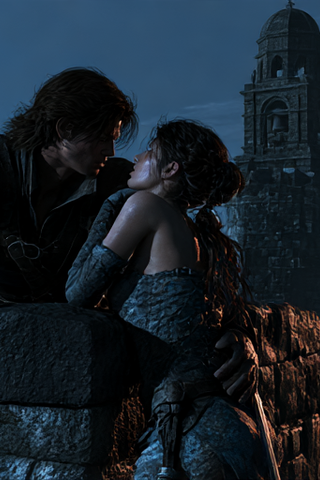
You have a week to kill the enemy's champion on the sand in front of both kingdoms, and last night he kissed you back.
Read Chapter 1 free
-

Wartime Enemies
The Knife Between Us
with Colonel Anton Rhyse
You came through the enemy colonel's window to kill him, and your own side came through the door to kill you both.
Read Chapter 1 free
Questions readers actually ask
What is a slow burn enemies to lovers romance?
It is a romance where two people begin in genuine opposition and the book delays their union while steadily changing what they understand about each other. The delay is the structure, not the point. Every stretch of waiting has to hand the reader something new, or the ache flattens into impatience.
How long should a slow burn last?
There is no correct page count. A slow burn can run three hundred pages or three books, and the only limit is how long the reasons keeping them apart continue to change. Once the same obstacle is restated a third time, the burn has stopped and the stalling has started.
What is the difference between slow burn and no chemistry?
Chemistry is the presence of want. Slow burn is the management of it. In a real slow burn, at least one of them wants to close the distance in every scene and something stops it. With no chemistry, nobody is reaching for anything, so there is nothing for the book to withhold.
Why does enemies to lovers hide bad pacing so well?
Because hostility is loud. A scene where two people snipe at each other feels eventful even when nothing shifts, so a stalled enemies to lovers book can read as busy for a hundred pages. Strip out the volume and ask what either of them learned, and the flatness shows immediately.
How can you tell early whether a slow burn is going to be worth it?
Watch the first argument they repeat. If the second version of a fight covers the same ground with the same accusations and neither position moves, the book has shown you its method. Books that are going to pay off escalate instead, raising what each person stands to lose.