
Vampire Romance, Explained: Why the Genre Refuses to Die
Vampire romance endures because the vampire makes restraint visible. He can kill her and everyone in the room knows it, so every moment he chooses not to becomes a demonstration rather than a given. Ordinary romance has to work hard to show a man choosing gentleness; vampire romance gets it in a single scene. That's the whole engine, and it hasn't worn out yet.
Every few years someone announces that vampires are finished. The genre had its moment, the argument goes, and readers have moved on to fae, or dragons, or whatever the current shelf looks like. And then a vampire book takes over BookTok again and everyone acts surprised.
They shouldn't. Vampires are not a trend. They're a delivery mechanism for something romance readers want permanently, and the delivery is unusually efficient.
What the vampire is actually for
Strip out the fangs and the vampire is a man who is dangerous, old, and hungry, and who wants you specifically.
Each of those does real work.
Dangerous means the gentleness is a choice. This is the mechanic underneath half of the tropes readers reach for — the same one running under morally grey love interests, where the appeal is never the cruelty but the contrast. A man who is kind because he has no other option is not interesting. A man who could do anything and puts his hands behind his back is.
Old means he has seen everything and is still undone by her. Immortality is a scale problem: when a character has watched centuries go past, "I've never felt this before" stops being a line and becomes a measurement. Nothing else in romance gives you that for free.
Hungry means his want is not metaphorical. Romance is a genre about appetite, and the vampire is appetite with the safety off — but crucially, appetite that has to be governed. The tension isn't whether he wants her. It's what happens when he stops managing it.
And wants you specifically is the part readers actually turn up for. Being chosen without ambivalence, by someone with unlimited options and unlimited time, is the fantasy. Everything else is scaffolding.
The sub-tropes worth knowing
If you're new to the subgenre, or you've read three and want to understand why one landed and two didn't, these are the moving parts.
The vampire king or court
The lone brooding vampire in a coat is one flavour. The other — increasingly the dominant one — is the ruler: a vampire with a court, politics, rivals, and a throne he might lose. This raises the stakes from personal to structural. Now her presence isn't just emotionally inconvenient, it's a political problem, and everyone at court has an opinion.
What makes it work is that she is the only person in the room who isn't afraid of him. Court intrigue is a machine for generating scenes where everyone else kneels and she doesn't. It's the richest strand in the subgenre, and the consort question underneath it is worth a longer look at the vampire king trope on its own terms.
The blood bond
The vampire genre's version of a mating bond: an exchange that ties two people together permanently, usually before either of them has agreed to anything.
This is a forced-intimacy device with a consent question welded to it, and the good books know that. A blood bond that simply makes two people love each other is a shortcut. A blood bond that makes two people feel each other's states while they are still actively hostile is a plot. The mechanics reward a closer read, so there's a full breakdown of the blood bond trope and how it differs from a mating bond.
The turning
The one decision no other subgenre can stage this cleanly. Someone has to give up their entire nature: she becomes what he is, or he surrenders what he is, or they run out of time.
Books that treat the turning as an obvious happy ending waste it. The interesting version treats it as the genuinely difficult question it is — she isn't choosing him, she's choosing to stop being human, and those are not the same choice.
The mortal who isn't impressed
The counterweight. If the human love interest spends the book being awed, there's no relationship, just an audience. The pairing only works when she has her own leverage — knowledge he needs, a refusal he can't override, or simply the nerve to be unimpressed by a man who has spent four hundred years being feared.
What separates a good one from a lazy one
Three things, reliably.
The hunger has to cost him something. If restraint is effortless, it isn't restraint. The scene readers remember is the one where he is visibly struggling and still doesn't move. Books that establish him as dangerous in chapter one and then never make him work again have spent their capital.
He has to be dangerous to someone. Not to her, necessarily — but if the reader is told he's terrifying and never sees it, the contrast has nothing to push against. Show him being genuinely frightening to a third party, then show him being careful with her, and the trope does its own work without a word of explanation.
The power gap needs an answer. He's stronger, faster, older and functionally unkillable. If the story never addresses that, the romance reads as capitulation rather than choice. The answer doesn't have to be magical — often the sharpest version is simply that she is the one person who can walk away, and he knows it.
The consent question the genre can't avoid
Every vampire romance has to answer one question, explicitly or by dodging it: what does consent mean when one party is functionally unkillable, can move faster than she can react, and in many versions can influence what she wants?
Books that ignore this produce a specific flat feeling. The romance reads as inevitable rather than chosen, and inevitability is the enemy of tension.
The versions that work tend to take one of three approaches. Some remove the compulsion entirely — he has no mind-influence, or refuses to use it, and the refusal is itself characterisation. Some make her immune, which converts a power imbalance into a fascinating problem for him. And some let the compulsion exist, have him use it once early, and spend the rest of the book living with what that cost him.
All three are better than pretending the question isn't there. The reader is already asking it.
Why now
The current wave is darker than the last one. Readers who came in through romantasy have been steadily reaching for stories with more moral complication — antiheroes, villain love interests, courts where nobody's hands are clean — and the vampire is native to that territory in a way most fantasy love interests aren't.
There's also the enemies-to-lovers overlap, which is doing a lot of quiet work. A vampire and a human who has every reason to want him dead is a functioning enemies-to-lovers setup before the author writes a single line of dialogue. The opposition is structural. Nobody has to manufacture a misunderstanding.
That's the real reason the subgenre keeps returning. It isn't nostalgia. It's that a vampire hands you danger, restraint, immortal stakes and built-in opposition in one character, and you can spend the entire book on the tension instead of on the setup.
If the appeal for you is the restraint — the wanting, the almost, the moment where he could and doesn't — that's the register we built MARKED in.
He's a vampire king. You're the one person at court who won't kneel. Your choices steer it, and he remembers every one — which becomes a problem roughly as fast as you'd expect.
Start reading MARKED free. If your taste runs elsewhere, the rest of the library starts free too — Unmated takes the mate bond somewhere considerably less forgiving, and The Ruin of Miss Everly moves the whole argument to a Regency season. Chapter 1 is free, no sign-up — start below.
Read it as a story
-
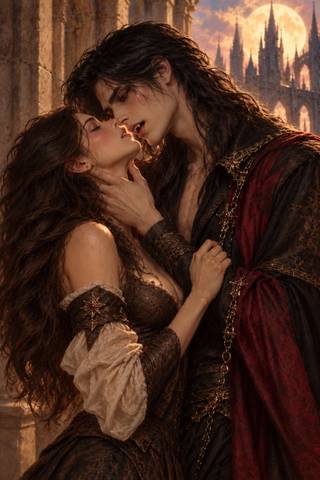
Dark Romantasy Vampire
Bloodbound
with Severin Morcant
Your blood is the one thing every vampire alive would kill for, and the only one who won't take it is the man you came to kill.
Read Chapter 1 free
-
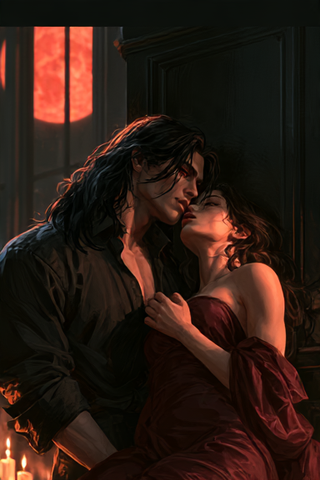
Dark paranormal romance
Marked
with Lucian Vale
One mouthful of your blood buys a vampire the sun. The King of this city had it on his lips and stopped — and now you have seven nights under his roof wearing his mark, and the only thing hiding you burns off every time he touches you.
Read Chapter 1 free
-
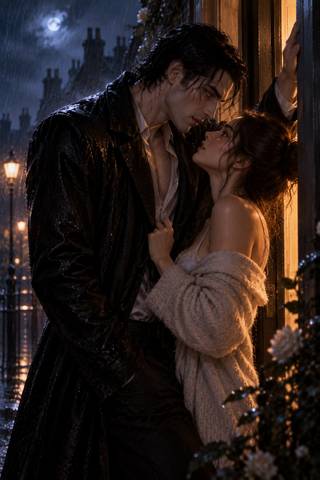
Paranormal rom-com
Ask Me Twice
with Bram Cullane
Your neighbour has dug your graves and drunk your tea on that step for years and still cannot come inside, because the door only opens for somebody in love with him.
Read Chapter 1 free
Questions readers actually ask
Why is vampire romance so popular?
Because the vampire externalises restraint. He is physically capable of destroying the person he wants, and every moment he doesn't is a visible choice. That turns ordinary romantic tension into something with stakes you can see on the page, which is why the subgenre outlives every announcement of its death.
What is the difference between vampire romance and dark romantasy?
Vampire romance is defined by what the love interest is; dark romantasy is defined by the moral register of the story. A vampire romance can be warm, funny and low-stakes. Dark romantasy is about characters whose choices are genuinely troubling. Plenty of books are both, but neither term implies the other.
What are the most common vampire romance tropes?
The vampire king or court, the blood bond, the turning question, the mortal love interest who refuses to be intimidated, and the sire relationship. Most vampire romances run two or three of these at once, and the bond and the turning tend to carry the emotional weight.
Is vampire romance the same as paranormal romance?
Vampire romance is a subgenre of paranormal romance, which also covers shifters, fae, demons and witches. What distinguishes the vampire strand is its focus on appetite and restraint — the central conflict is usually about hunger being controlled, rather than about a bond being discovered.